Update on across-the-board testing of SVK citizens for COVID-19 (as of 20 Oct 2020)
- Author:
- Photo:
- Date: 20.10.2020
- Share: Zdieľať na Facebook
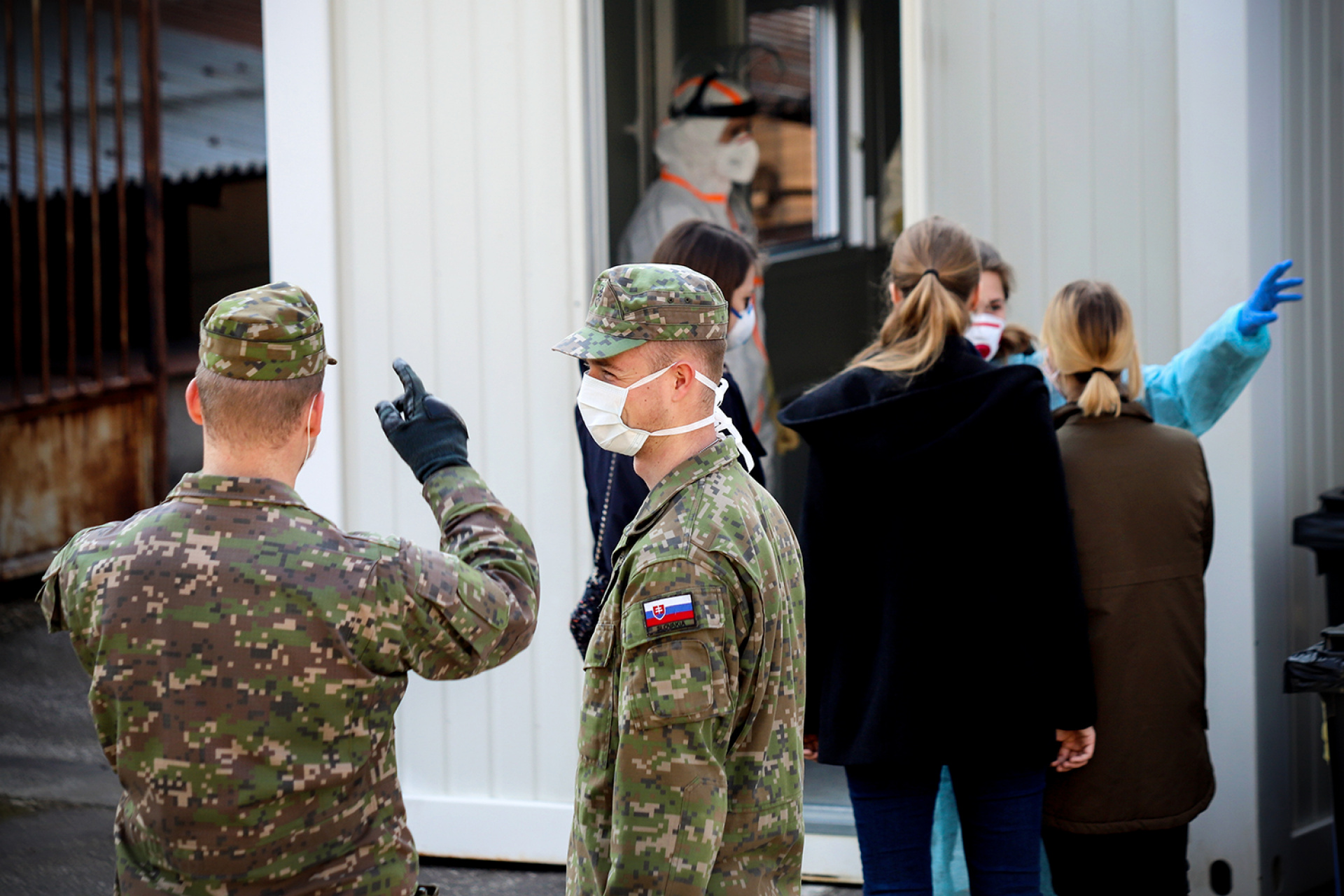
Today, Defence Minister Jaroslav Naď and Chief of Defence Gen Daniel Zmeko provided an update to President and Commander-in-Chief of the SVK Armed Forces Zuzana Čaputová and to members of the SVK Security Council on all aspects of across-the-board, nation-wide testing of SVK citizens for the presence of COVID-19. “Already today, the number of unanswered questions is small,” the head of the MOD stated.
Ultimately, the current challenge is to ensure that sufficient numbers of civilian personnel, be that medical professionals or administrative aids, are available to support the testing efforts. Those interested in signing up to help can fill out a form at www.korona.gov.sk. Given that current legislation limits, to a certain extent, the options for medical staff to be involved in such testing efforts, a legislative amendment is being drafted to give a precise definition of a medical worker’s status, one which will specifically delineate all those who are authorised to perform such tests.
For non-medical personnel, it will soon be possible to sign up to help with testing at an MOD website, which is now under development. Apart from a sense of togetherness and solidarity, those willing to help will be given a financial reward of 50 euros per day, as with the polling station staff during the general election.
Our priority is to make sure that the people who will participate in testing are safe. For this reason, all measures will be approved by the Regional Public Health Authority, ranging from disinfectants, personal protective equipment (PPE), distancing, through to testing site arrangements, swab testing, and waiting for test results.
All those interested in taking the swab test will be able to do so at the nearest testing site where they currently live. Most importantly, they must be aware that, if tested positive for coronavirus, they will be expected to go, as quickly as possible, to the place where they will self-isolate, while this may not necessarily be their place of residence. Positive cases must be kept in quarantine for the 10-day quarantine period. If they display no symptoms after 10 days, they are allowed to leave quarantine. Checks on quarantine measures in place will be performed in line with the laws of the Slovak Republic. The public will be informed of how the checks will be conducted in the coming days.
On maximum numbers to be tested at individual testing sites, the MOD is prepared for the absolute maximum testing capacity. Local residents will be kept informed of the ongoing testing arrangements, among others, via the public address system. High turnout is expected at the testing sites in the Bratislava region.
All data will be collected, forwarded to and processed by the National Medical Information Centre (NCZI). The data will be collected under strict arrangements without the use of electronic devices to ensure maximum security and will be available to the Regional Public Health Authority (RÚVZ), whereas only medical staff will be allowed to access medical information.
Exemptions from across-the-board testing of the SVK population include pensioners in care homes and patients at hospitals who will be tested on-site. This also applies to patients diagnosed with such diseases where it would be unreasonable for them to take a test on different medical grounds.
Testing is not recommended for elderly people aged over 65 who stay at home most of the time. Nor will immobile patients be subject to testing. Their low mobility presents no risk of spreading the virus. Testing is also not required for those who can complete a 10-day quarantine. Current epidemiological measures remain in place. Provided that there is high testing turnout and while keeping the confirmed positive cases in quarantine, the free across-the-board testing of the SVK population is expected to bring the spread of the virus under control.
The Ministry of Defence is strongly opposed to the statements appearing in the media according to which responsibility vis-à-vis the self-governing authorities is being evaded. In fact, the self-governing authorities have been engaged in intense communications with service personnel who have set their communications channels as part of Op Shared Responsibility and keep the self-governing authorities informed, timely and comprehensively, of all matters related to testing. This mainly concerns the provision of personal protective equipment (PPE) and the requirements of the SVK Armed Forces for spaces and technical support for testing. To illustrate this point, each testing team requires a table with chairs, an extension cord, and a waste bin.
