Defence Minister J. Naď views his first 100 days in office as a demanding period, whilst providing a good basis for the future of Defence
- Author:
- Photo:
- Date: 27.06.2020
- Share: Zdieľať na Facebook
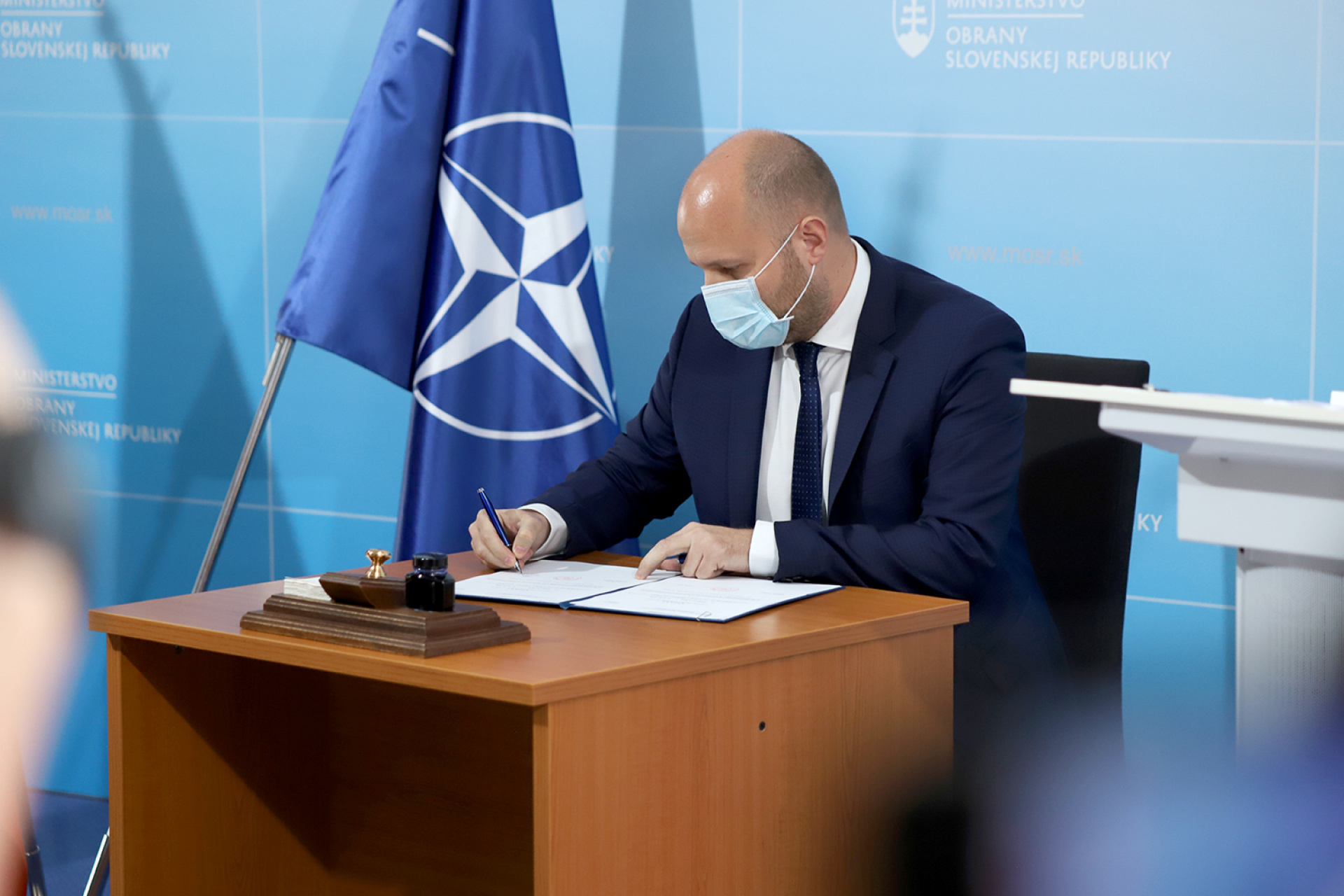
Reflecting on his first 100 days in office as Defence Minister, Jaroslav Naď remarked that it was a demanding period full of challenges, whilst providing a good basis for the future of Defence. His first decisions and measures were intended to provide assistance to the State in the fight against the COVID-19 pandemic. From Day 1, he focused on introducing and applying the principles of subject matter expertise, open communications and transparency across Defence.
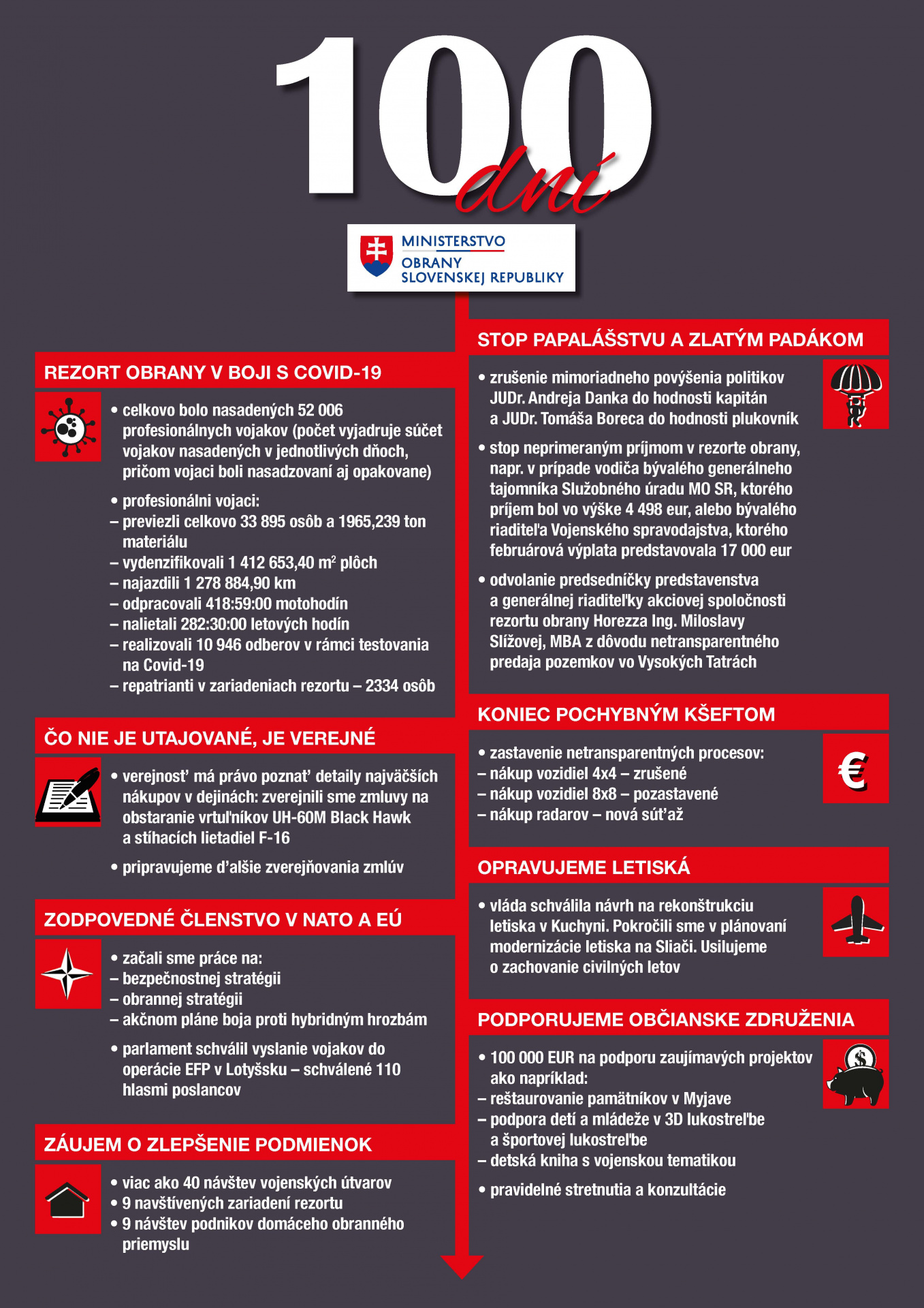
In his assessment of his first 100 days in office, he said: “The pandemic period was demanding not only for the newly incoming government, but also for the whole of Slovakia. At the same time, it provided excellent evidence of the Armed Forces' significance within the domestic crisis management structures. Our soldiers did an amazing job and, as the Defence Minister, I am duly proud of their achievements. In difficult times, they were a real mainstay for the State.” Statistically, 1,500 soldiers a day were deployed on the ground to halt the spread of the pandemic. A total of 33,895 people and 1,965,239 tonnes of material were transported, 1,278,884.90kms were covered, 418:59:00 driving hours were completed, and 282:30:00 flying hours were clocked. Soldiers were also involved in COVID-19 testing, taking a total of 10,946 swab samples. They also made their own disinfectants and disinfected over 1,412,653m² of spaces. During the coronavirus crisis the MOD provided accommodation for 2,334 repatriates in its quarantine centres.
The state of play of Defence left behind by the outgoing MOD leadership, too, compelled the attention of Minister Naď on taking up his appointment as Defence Minister. "To the Ministry of Defence, I brought three basic principles which I consider as important in Defence – subject matter expertise, open communications and transparency," explained Minister Naď, justifying his next decisions. These included measures on the ongoing modernisation programmes – cancelling the purchase of the 4×4 Multirole Tactical Vehicles and reviewing the procurement of the 8×8 Armoured Infantry Fighting Vehicles, checking how defence estate was managed and making related personnel decisions, putting an end to the practice of excessive salaries in Defence, "so that no driver would earn 4,000 euros and no Director of Military Intelligence 17,000 euros."
Equally important, the Minister wants to see classified contracts declassified where possible and made public. "Our citizens have the right to know how the money they pay as tax is spent. That is why we will keep only those classified documents secret where it is necessary to deliver the security of our country, and not for the purposes of theft as was the case in the past. We published the UH-60M Black Hawk and F-16 contracts, while today we are examining ways to disclose other purchase contracts awarded for military equipment," he said.
Over the given period, Defence Minister Jaroslav Naď along with State Secretary Marian Majer also focused on framing the new Security and Defence Strategies of the Slovak Republic and drafting the Action Plan for the Fight Against Hybrid Threats. The head of the MOD approached cooperation with foreign political leaders proactively, thus acknowledging our responsible membership in NATO and the European Union. One of these steps was the proposal for the SVK operational deployment to Latvia as part of NATO's enhanced Forward Presence until the end of the eFP mission. The proposal won 110 votes in Parliament, which markedly exceeded the total number of all coalition votes.
One of the main goals of the acting MOD leadership is to determine the real state of armed forces, military equipment, infrastructure, and Service conditions. As a result, Minister Naď has visited over 40 military units over the past four months and he has personally seen the state of munition depots, MOD-run enterprises and joint stock companies. On these, he said: "Only if we know the reality and speak with people who work in them about the current circumstances will we be able to take effective measures. On my tour of military installations, I often found myself appalled. That is why I want to regularly visit our military units and facilities and be kept informed of the most compelling problems the solutions to which may not cost millions of euros, but rather require one's willingness and interest. I was surprised to see that even the soldiers themselves were not used to this." On military infrastructure, the MOD leadership has already taken steps to refurbish Kuchyňa and Sliač Air Bases.
Minister Naď also aims to forge close cooperation with NGOs, which recently received 100,000 euros in grants from the MOD. Grants were awarded to projects such as Renovation of Monuments in Myjava, Protection and Development of Historical and Cultural Heritage with Focus on Military History, Restoration of Death Valley Battlefield, and Supporting Children and Young People in 3D Archery and Sport Archery. Moreover, the head of the MOD decided to increase funding for the civic associations and NGOs dedicated to the SVK military's themes.
Summing up the key points of his first 100 days in office, Defence Minister Jaroslav Naď said: "Over the first 100 days in office I was fully committed to addressing current issues and I am looking forward to taking on new challenges and seeing through our goals. Clearly, among them are open communications, subject matter expertise, transparency, Slovakia's delivery of EU and NATO commitments, responsible and full-fledged partnerships, solutions to new security challenges, a systemic and transparent modernisation of armed forces, and an improvement in the quality of Service conditions for soldiers."